Robert Frost had it right.
Fences are disruptive to neighborhoods. Current urban and suburban trends are toward open space instead of closed off by “privacy fences”. State and local laws regulate fence construction but many communities do not enforce them. According to state ordinance the only reason for fences is to contain domestic animals
The type of fence depicted in this article is commonly referred to as a “hate fence”. It does not enclose the property, does not provide privacy and does not control domestic animals.
A poorly designed, installed and/or constructed fence decreases the value of all property in the neighborhood and the community as a whole. They are considered an eyesore and blight.
In 2021 a fence was installed in the neighborhood. I was told it would be styled like a Japanese fence. My Asian friends comment the fence owner must be a racist assuming the Japanese would construct a fence with so many flaws. I asked but no plan was shared. It was stated the fence would enclose the yard but that has not followed for two years now The only thing said which seems to be true is the owner would put up a “fence like structure”.
Judge for yourself but it appears the fence is poorly designed, carelessly constructed, shows a lack of basic construction skills / principles, shows a misunderstanding of the law and lack of good judgement.
Watching the fence owner make poor technical choices in my opinion show careless behavior and demonstrates a lack of skills. When the fence owner changed their statement that instead of digging the holes manually they would be dug by a tractor mounted auger. All considered, I became very concerned there would be damage to a recently completed stone retaining wall on my property.
When I explained my concerns, the property owners response didn’t calm my fears but instead increased them. It seems I was not alone as a different person previously expressed concerns the retaining wall on their property line would be damaged.
The only course of action left was to state, “if the fence installation disturbed my retaining wall the owner would have pay for it’s repair and /or reconstruction”. The property owner decided independently to move the fence back from the property line about a foot. Not because it was my idea but because that was what they decided independently and it has not worked out well since.
ISSUES
Preparation
Drilling the post holes
Due to two neighbors concerns the property owner elected to move the fence about a foot inside their property line.
Where roots were encountered they were hacked off instead of working around the roots causing damage to the trees. The property owner climbed onto a not solid auger devise attempting to force it into the ground by adding their body weight.
On observation there was not enough room to move the auger and tractor into a proper position to safely drill holes. There were difficulties aligning the auger for several holes and the holes wandered from their intended location.
Not Legally Installed
Site plan requirement
Local ordinance states that a site plan and permit is to be completed before a fence is installed. That plan is to be shared with neighbors and the village to agree as a fence affects their property values too. On checking with village officials no plan or permit was filed, fees were not paid and the village official stated that the fence was installed illegally. The ordinance appears below
- Any person desiring to build or cause to be built a fence upon property within the Village of Manchester shall first apply to the Zoning Administrator for a permit. Application for the permit shall contain any and all information, including site plan and opacity, which are required and necessary for the determination of whether the erection of the fence would be contrary to the provisions of this chapter. The fee for the permit shall be set by Council resolution.
Front Yard Height Ordinance
Michigan Fence Ordinance when the fence was installed states fences in the front of a house are not to exceed 4 feet in height. This is the fence at 6 feet in height. When it was reported to the village offices no action was taken to ensure compliance with state code.
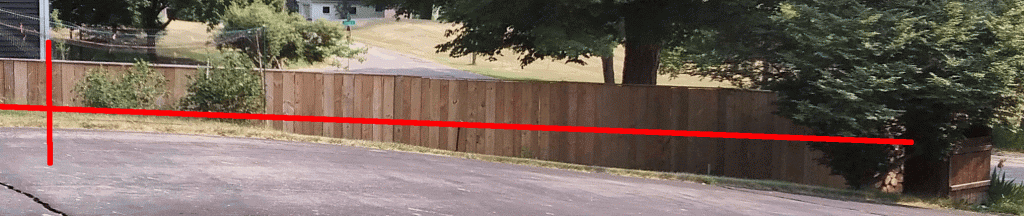
- In a residential district, fences shall not exceed 8 feet in height. However, fences in the required front yard shall not exceed 4 feet in height and 50% opacity. Opacity is the degree to which a fence is impervious to rays of light. This condition shall be measured by the observation of any 2 square yard area of fence between 1 foot above the ground level and the top of the fence. The observation shall be from a direction perpendicular to the place of the fence.
Fence Outside Property
I paid for line survey to ensure the property line as some markers were removed without my knowledge. The markers are accurate and the property plot marker was confirmed (concrete marker) in picture. The fence in question is installed over a foot beyond the property in the roads easement.
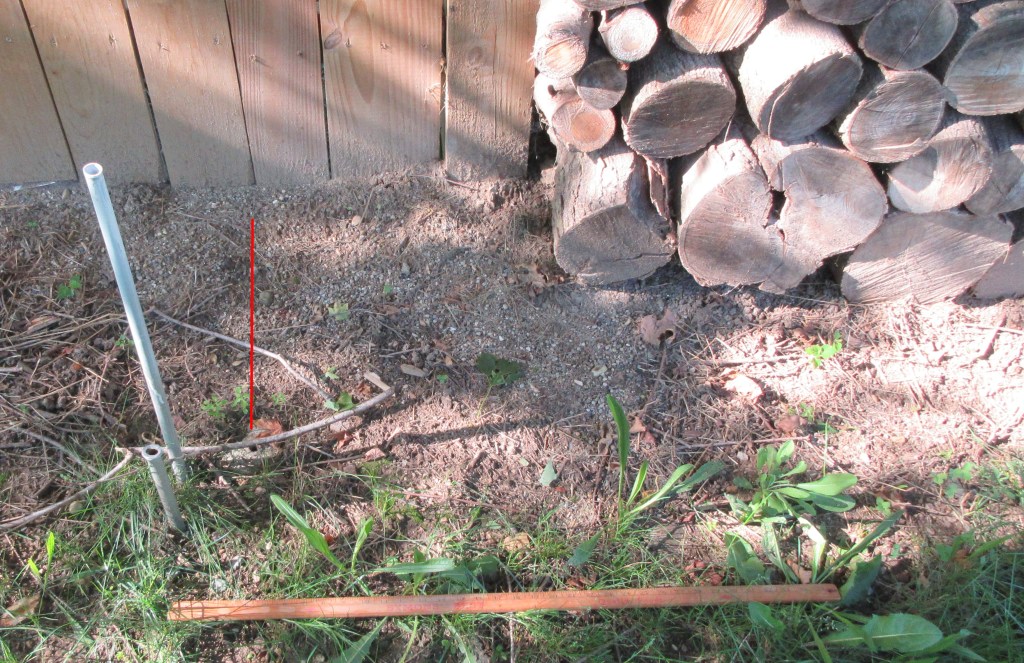
Not To Construction Standards – Imagine your house built to these standards.
Crooked Alignment
The fence seems to be missing vertical or horizontal alignment. The result is a course that i not straight leading to to an unsightly (doesn’t look right) installation. If the installation had been on the property line it would surely have crossed into my property.
Fence Poles Not Plumb
6” timbers are heavy and need additional support while setting. Because standard construction techniques were not followed to accurately plumb the fence poles they are inconsistently out of plumb. This caused inaccurately installed planking. The construction appears random which is compounded by some poles not being cut to the correct length and the resulting patching and inconsistencies between the poles.(See top rail issues below)
Fence Rails Not Supporting Planking
The installation of two inconsistently spaced fence rails does not adequately support the planking. Common design and construction principles (three rails) was not followed leading to inconsistent warping and a random, inconsistent, and disorganized appearance and panel construction.
Inconsistent Gaps In Planking
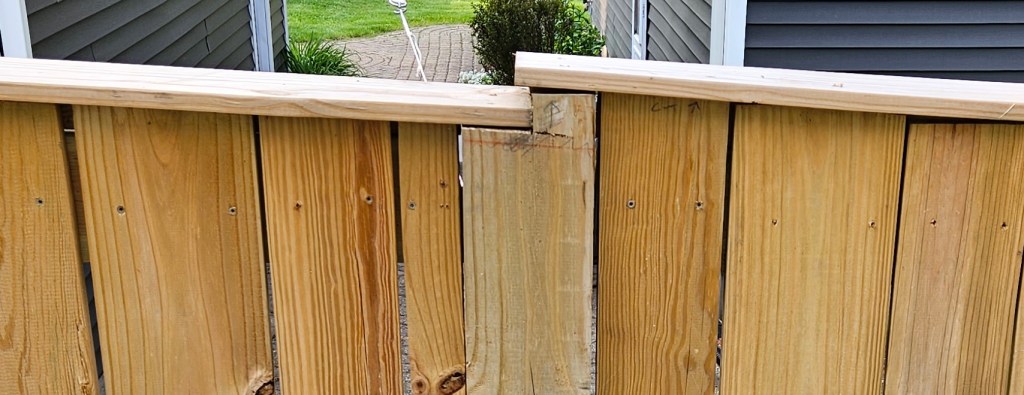
As an outcome of the prior construction issues, the installation of planking did not allow for the clean, consistent installation of planking. In this case the boards are not plumb or parallel. On occasion trapezoidal boards are required as fillets to compensate for the inaccuracy. The planking was not sized causing nonparallel edges which adds to the slipshod appearance of the fence. This is further emphasized by the failure of the installer to use a planking gaping tool. Not only do the gaps look inconsistent but when back-lit the inconsistencies are exaggerated. Due to improper spacing and not being careful with cut, the fence boards bow inconsistently with weather changes. The panel in the images is bowing a bit over 3 inches out of alignment.
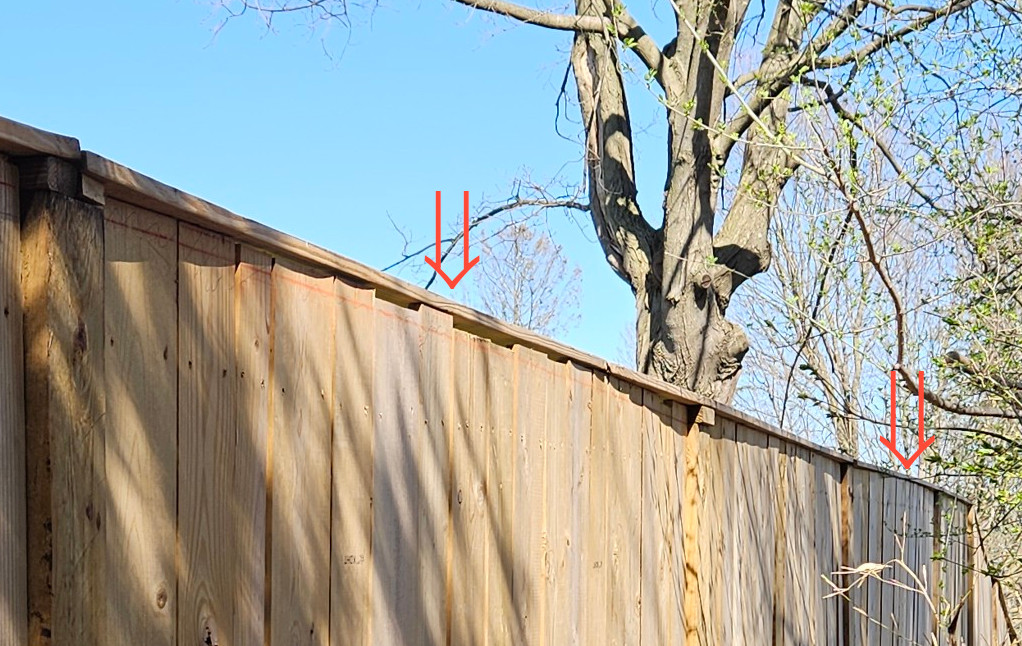
Inconsistent Gaps
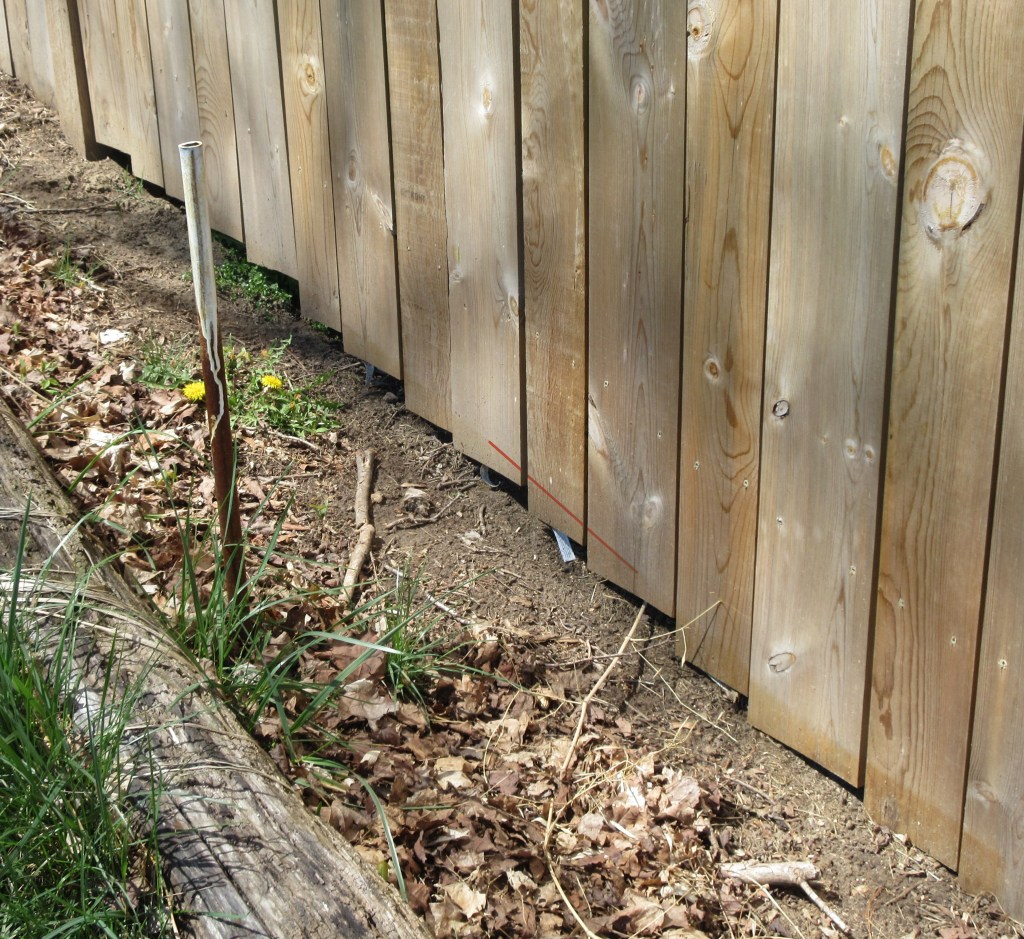
Due to the inconsistent board length, random distance to the ground and top board show careless construction. The fence owner cut the boards to illogical lengths for the application driving some boards into the ground while leaving some boards 6+ inches above the landfall. A similar variation exists at the top where some boards leave gaps of inches and are unevenly cut. The fence owner used the dangerous technique of freehand cutting a line with a circular saw. Because the cut was unguided variation is often exaggerated.

Top Rail Issues
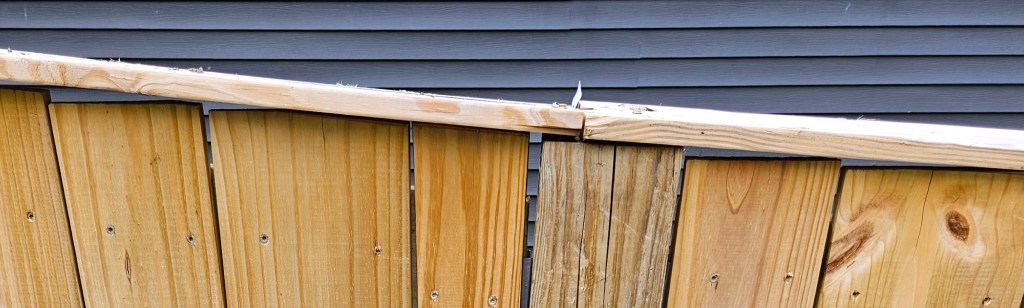
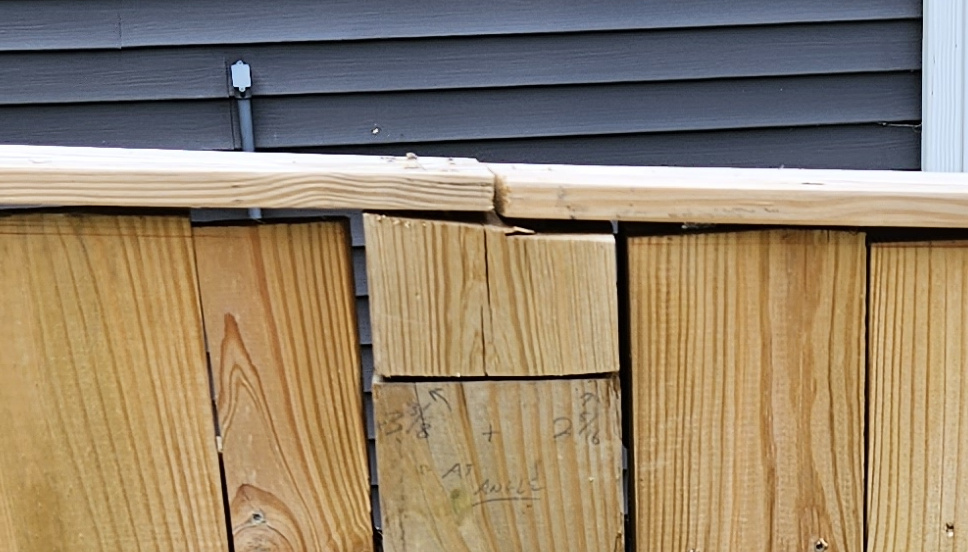
The top rails are not installed or constructed correctly. Top boards do not follow the contour of the ground and are warping at an inconsistent rate. Failure to create an expansion channel for the top boards emphasizes the inconsistent length of the planks and gaps .
Bottom Rail Issues
The fence boards were not cut t a consistent length or to the contour of the land leaving up to 6″ gaps in some areas. The red line indicates the 6″ filler mark left by the boards used in the next entry.
Unsightly Patching and Maintenance
Gap Fillers
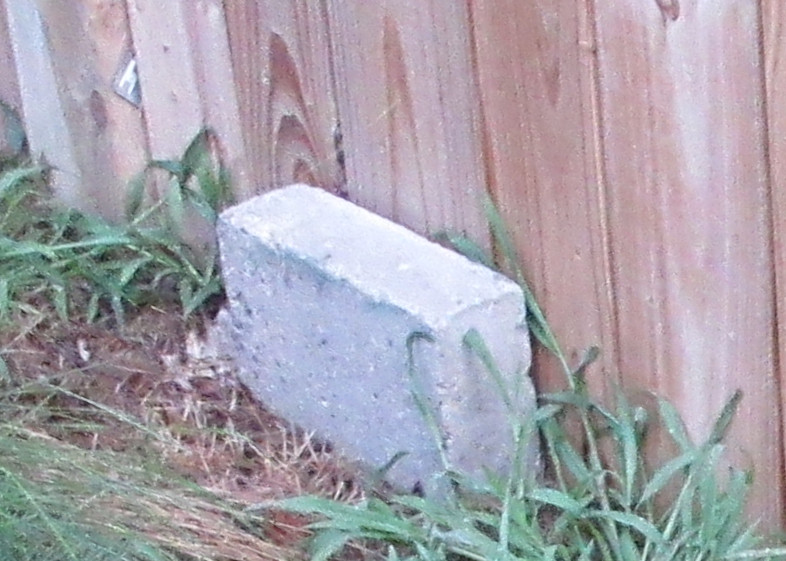
Because the top and bottom gaps, animals have gone under the fence. To resolve this flaw several items have been placed on the side of the fence toward my property to fill the gap including concrete blocks and boards. This adds to an unsightly appearance of the fence and property.

Cobbled Fixes
Because of the fence board placement issue and untrue nature of the construction throughout, panels experience inconsistent warping. It also appears the fence owner does not understand about board grain so installed boards mixing sides causing inconsistent warping direction.
To address this issue the fence owner makes kludgy attempts to correct inconsistent plank warping and misalignment contributing to the shabby nature of the fence.
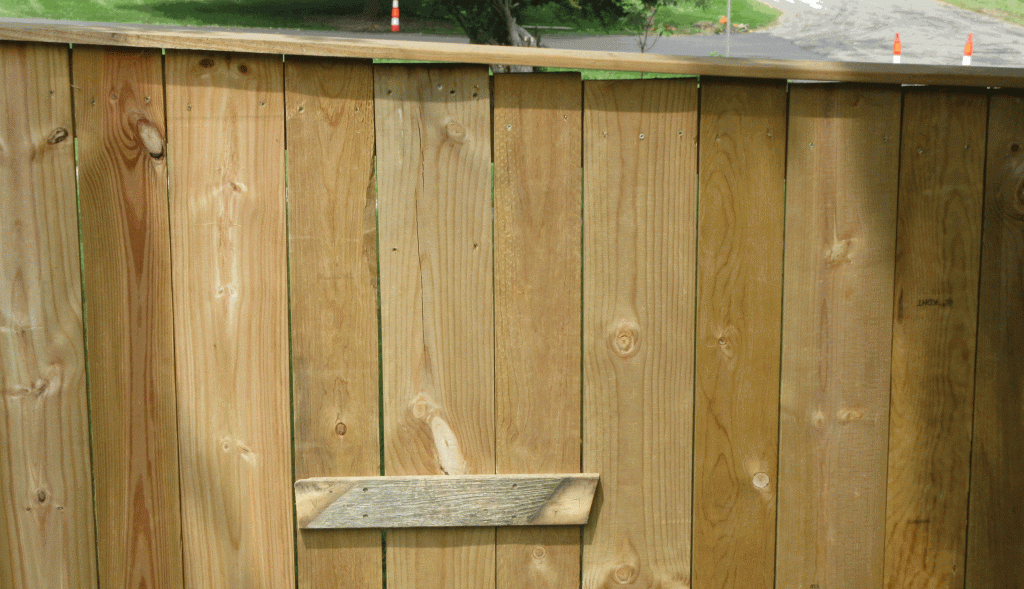
The fence owners damaged the top rail by cutting a limb. The top has been broken for several weeks and could be fixed for less than $20 so remains an eyesore.
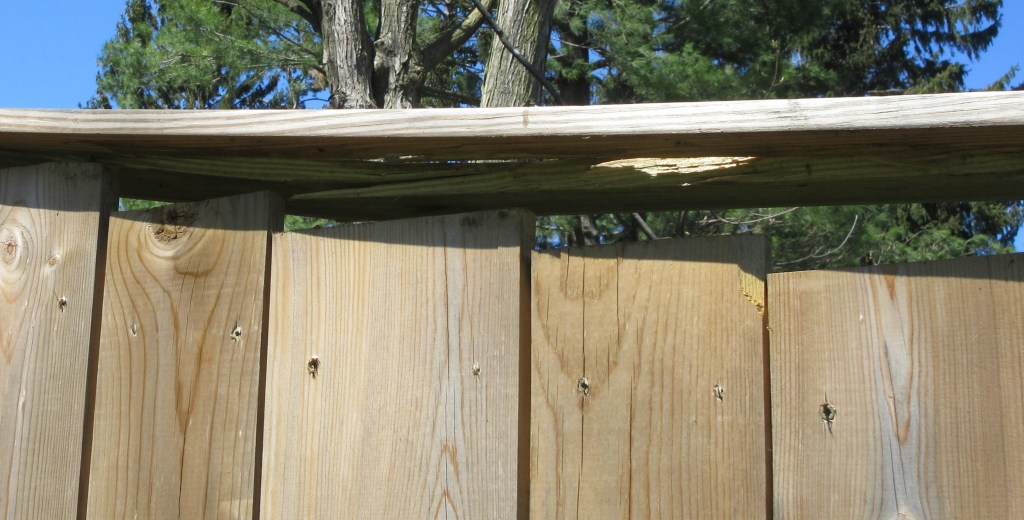
Today, after several weeks the fence was repaired and it looks slightly better. Maybe the next limb that falls on it won’t do as much damage.
So what do you think. Am i that far off, is this fence of proper quality, using proper construction techniques or an unsightly blight. Please give your opinion and why you feel so.
 What's next?
Leave a comment